


 Cart
Cart
 sales@molnova.com


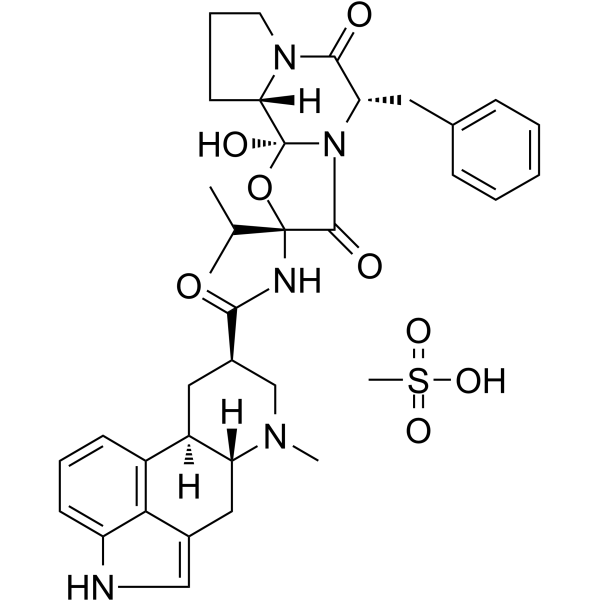
Dihydroergocristine mesylate
CAS No. 24730-10-7
Dihydroergocristine mesylate( DHEC (mesylate) )
Catalog No. M26163 CAS No. 24730-10-7
Dihydroergocristine mesylate(DHEC mesylate) is the methanesulfonic acid salt of dihydroergocristine.
Purity : >98% (HPLC)
 COA
Datasheet
HNMR
HPLC
MSDS
Handing Instructions
COA
Datasheet
HNMR
HPLC
MSDS
Handing Instructions
| Size | Price / USD | Stock | Quantity |
| 5MG | 110 | Get Quote |


|
| 10MG | 177 | Get Quote |
|
| 25MG | 299 | Get Quote |
|
| 50MG | 446 | Get Quote |
|
| 100MG | 608 | Get Quote |
|
| 200MG | Get Quote | Get Quote |
|
| 500MG | Get Quote | Get Quote |
|
| 1G | Get Quote | Get Quote |
|
Biological Information
-
Product NameDihydroergocristine mesylate
-
NoteResearch use only, not for human use.
-
Brief DescriptionDihydroergocristine mesylate(DHEC mesylate) is the methanesulfonic acid salt of dihydroergocristine.
-
DescriptionDihydroergocristine mesylate(DHEC mesylate) is the methanesulfonic acid salt of dihydroergocristine. It has been used as the for the symptomatic treatment of mental deterioration associated with cerebrovascular insufficiency and in peripheral vascular disease. Dihydroergocristine mesylate is a inhibitor of γ-secretase (GSI), , reduces the production of the Alzheimer's disease amyloid-β peptides, binds directly to γ-secretase and Nicastrin with equilibrium dissociation constants (Kd) of 25.7 nM and 9.8 μM, respectively. It is also a component of ergoloid mesylate (codergocrine mesilate), a mixture of ergot alkaloid derivatives that is used as a vasodilator and has shown mild benefits in the treatment of vascular dementia. It has a role as a vasodilator agent, an alpha-adrenergic antagonist and a geroprotector. It contains a dihydroergocristine.(In Vitro):The IC50 value(2-20 μM; 24 hours) of Dihydroergocristine (DHEC) for inhibiting the activity of γ-secretase in T100 cells without affecting cell viability is 25 μM.Dihydroergocristine (2-20 μM; 24 hours) inhibits cellular Aβ production and causes a dose-dependent accumulation of carboxy-terminal fragments of APP (APP-CTFs) in HEK293 and decreases γ-secretase activity in fibroblast cells.
-
In VitroDihydroergocristine (DHEC) (2-20 μM; 24 hours) has an IC50 value of 25?μM for inhibiting the activity of γ-secretase in T100 cells without affecting cell viability. Dihydroergocristine (2-20 μM; 24 hours) inhibits cellular Aβ production and causes a dose-dependent accumulation of carboxy-terminal fragments of APP (APP-CTFs) in HEK293 and decreases γ-secretase activity in fibroblast cells. Western Blot Analysis Cell Line:WT HEK293 cells; Fibroblast cells Concentration:2 μM, 5 μM, 10 μM, 20 μMIncubation Time:24 hours Result:Increased APP-CTFs accumulation in a dose-dependent manner.
-
In Vivo——
-
SynonymsDHEC (mesylate)
-
PathwayMembrane Transporter/Ion Channel
-
TargetBeta Amyloid
-
RecptorCNS
-
Research Area——
-
Indication——
Chemical Information
-
CAS Number24730-10-7
-
Formula Weight707.84
-
Molecular FormulaC36H45N5O8S
-
Purity>98% (HPLC)
-
SolubilityIn Vitro:?DMSO : 50 mg/mL (70.64 mM)
-
SMILESCS(O)(=O)=O.CC(C)[C@@]1(NC(=O)[C@@H]2C[C@H]3[C@@H](Cc4c[nH]c5cccc3c45)N(C)C2)O[C@@]2(O)[C@@H]3CCCN3C(=O)[C@H](Cc3ccccc3)N2C1=O
-
Chemical Name——
Shipping & Storage Information
-
Storage(-20℃)
-
ShippingWith Ice Pack
-
Stability≥ 2 years
Reference
1.Borlongan CV, Sumaya IC, Moss DE. Methanesulfonyl fluoride, an acetylcholinesterase inhibitor, attenuates simple learning and memory deficits in ischemic rats. Brain Res. 2005 Mar 15;1038(1):50-8.
molnova catalog



related products
-
β-Amyloid 1-17
This synthetic peptide consists of amino acids 1 to 17 of beta amyloid protein. This peptide can be employed in beta amyloid solubility studies.
-
β-Amyloid 29-40
β-Amyloid (29-40) is a fragment of Amyloid-β peptide.Alzheimer's beta amyloid peptide (29-40/42) C-terminal fragments have physical and chemical properties related to those of fusion peptides of viral proteins. The fusion of liposomes can be induced by these peptides in vitro.
-
MDR-1339
MDR-1339 is a blood-brain-barrier-permeable inhibitor of amyloid-β (Aβ) aggregation.
